
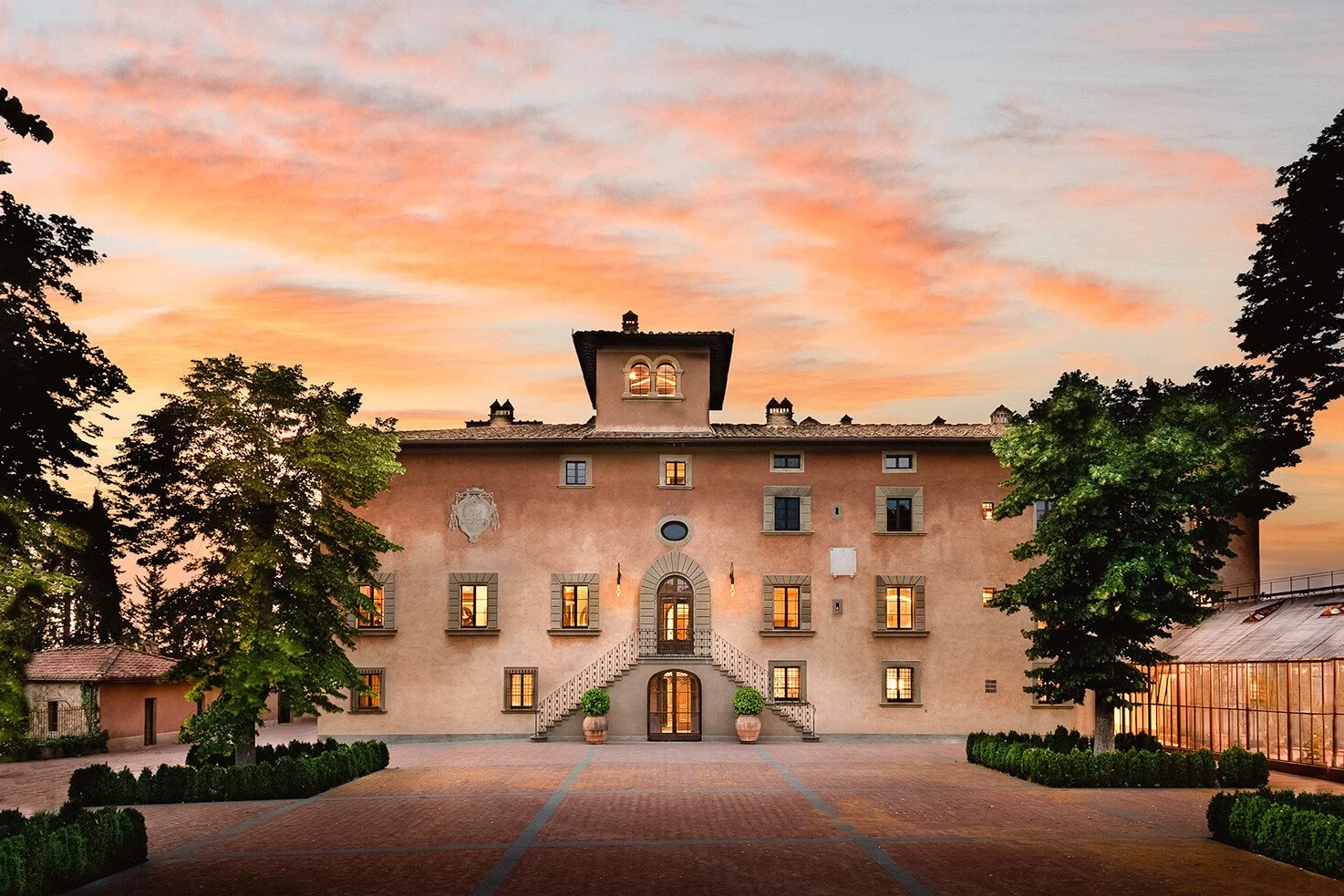
The evolution of the Tuscan estate from a medieval fortification to a global standard of luxury hospitality finds its most compelling contemporary expression in the restoration of Borgo di Vignamaggio. Situated in the heart of the Chianti Classico region, specifically within the upper Val di Greve, this fifteenth-century hamlet represents a sophisticated synthesis of Renaissance heritage and avant-garde design. After three decades of dormancy and neglect, the estate underwent a meticulous seven-year restoration process that concluded with its reopening as an exclusive event venue and luxury retreat. The significance of Borgo di Vignamaggio extends beyond its physical architecture; it serves as a cultural bridge between the historical lineage of the Gherardini and da Verrazzano families and the modern requirements of high-tier international tourism and destination weddings.
Historical Evolution and the Lineage of the Estate
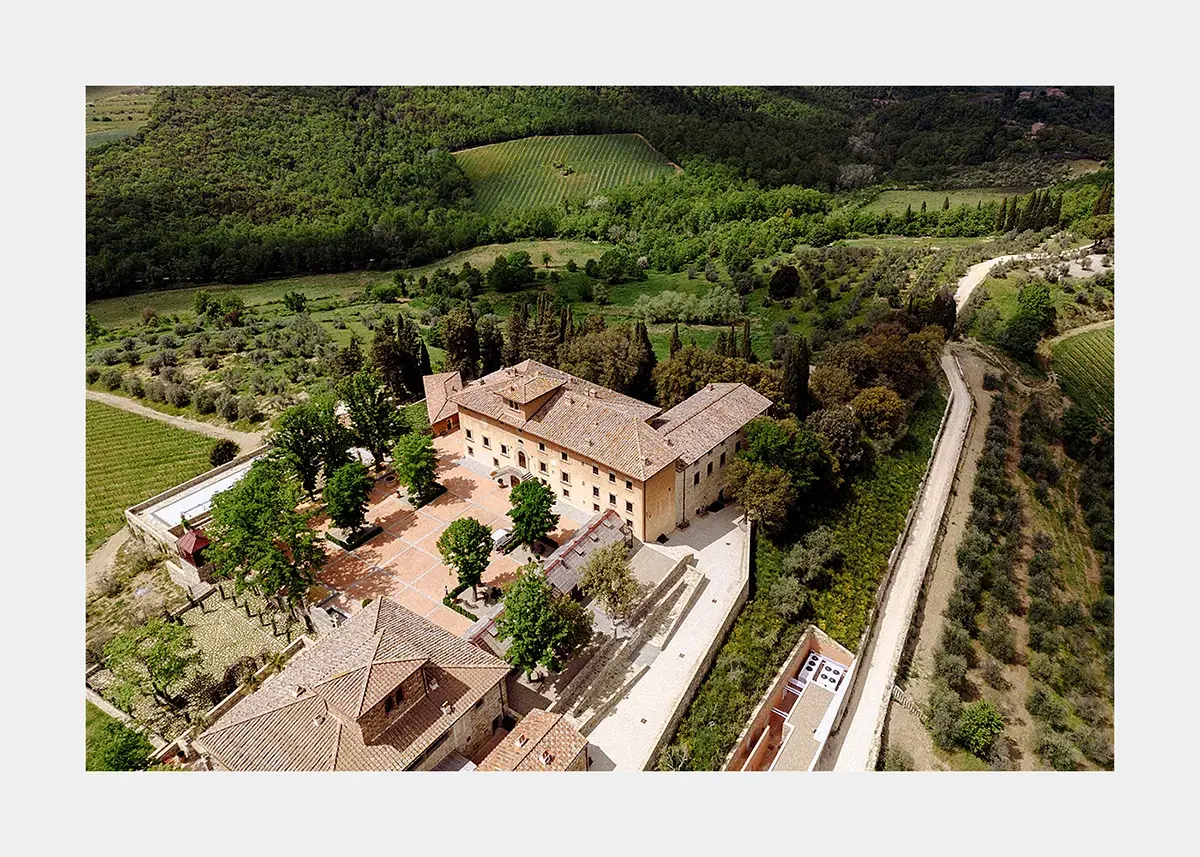
The historical narrative of Vignamaggio is inextricably linked to the broader socio-political shifts of the Tuscan Renaissance. The origins of the estate date back to the thirteenth century, when the noble Gherardini family established a castle at Montagliari, overlooking the Greve River valley. The strategic importance of this location led to significant conflict; in 1302, following the family’s involvement with the White Guelphs and their opposition to the Black Guelphs in Florence, the castle at Montagliari was destroyed by Florentine forces. This forced the Gherardini family to relocate to the opposite side of the valley, establishing what would become the Vignamaggio estate. This relocation marks the transition from a defensive military posture to an agricultural and residential focus, laying the groundwork for the fifteenth-century villa that stands today.
The estate’s connection to global history is punctuated by the da Verrazzano family, who owned the rich farmlands and manor in the fourteenth century. Giovanni da Verrazzano, the celebrated explorer who discovered the bay of New York in 1524, is believed to have spent his youth among the olive orchards and woods of this estate. This connection provides a profound historical resonance for international visitors, particularly those from North America, as the estate represents a tangible link to the earliest European explorations of the New World. The presence of Giovanni’s brother, Girolamo, a cartographer, further emphasizes the estate's role in the Renaissance spirit of geographic and scientific inquiry.
By the early fifteenth century, Vignamaggio had transitioned from a mere settlement into a functional homestead. Documented evidence from 1404 confirms that winemaking was already a core activity of the estate, a tradition that has persisted for over six centuries. The subsequent transfer of the property to the Gherardi family, wealthy silk merchants and allies of the Medici, in 1421, signaled a new era of expansion and integration into the Florentine economic elite. Under the Gherardi family, the estate developed into a complex agricultural system involving seventeen smaller farms under a sharecropping arrangement, producing wine, oil, silk cocoons, and various fruits.
The twentieth century brought further transformation through the Sanminiatelli Counts, who acquired the estate in 1926 and fostered a period of artistic and cultural patronage. However, the economic pressures of the mid-century led to a decline, and the property eventually fell into neglect following the Second World War. The modern reawakening of the Borgo began in 2017, when the current owners of the adjacent Vignamaggio palazzo initiated a comprehensive project to restore the "Sleeping Beauty" of the hamlet.
Historical Era Key Owners/Families Primary Developments
13th Century Gherardini Family Construction of Montagliari castle; military focus
1302 Florentine State Destruction of Montagliari; relocation to Vignamaggio
14th-15th Century da Verrazzano Family Early Renaissance homestead; childhood home of Giovanni da Verrazzano
1421 - 1831 Gherardi Family Agricultural expansion; formalization of wine and silk production
1926 Sanminiatelli Counts Cultural center; hosting of intellectuals and celebrity guests
1936 Egidio Favi Ownership by owner of La Nazione; integration of international ideas
2017 - Present Current Ownership Seven-year restoration; transition to ultra-luxury event venue
The transition from a working agricultural farmstead to a luxury hospitality venue required a delicate balancing act. The restoration had to be sensitive to the history of the site while simultaneously competing with a global standard of the best hospitality interiors, architecture, and design. This involved not just the physical repair of stone walls and roofs but the reimagining of spaces such as wine cellars and barns into theaters and banquet halls. The result is a venue that feels historically rooted yet entirely contemporary, avoiding the cliché "dusty rose" aesthetic often associated with Tuscan estates in favor of a fresh and poetic décor.
Architectural Philosophy and Restoration Metrics
The restoration of Borgo di Vignamaggio is characterized by a "versatile approach" where historical preservation meets global hospitality standards. The project was led by architect Patrice Taravella, whose vision focused on maintaining the soul of the Renaissance roots while introducing contemporary elegance and functional modernity. The design language utilized throughout the hamlet emphasizes high-quality natural materials, clean architectural lines, and a curated sensory experience, most notably the pervasive scent of cypress that characterizes the interiors.
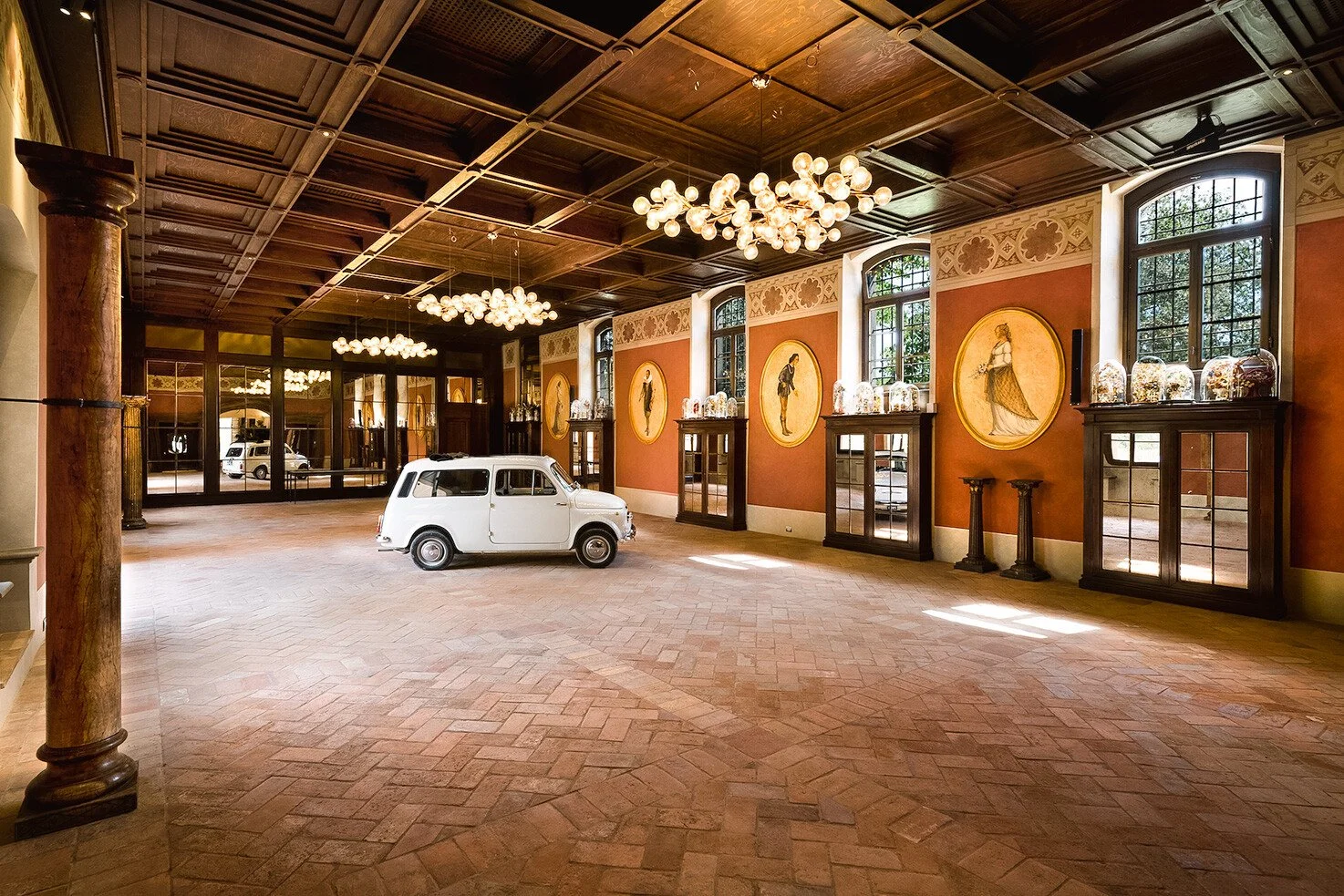
The attention to detail is evident in the selection of furnishings and lighting, which involve collaborations with prominent Italian design firms such as Viabizzuno, Davide Groppi, Fornace Brioni, and Baxter. This integration of modern design elements within fifteen-century structures creates a "beautiful, complimentary contradiction" where the venue feels both exclusive and homely. A significant logistical and aesthetic improvement involved the removal of all telephone poles and electricity wires across the 400-hectare estate, ensuring unobstructed "storybook views" of the Chianti hills.
The Core Infrastructure of the Borgo
The hamlet is organized around a series of multifunctional spaces designed to host a variety of events, from intimate weddings to high-level corporate seminars. The main villa serves as the focal point, housing seventeen double suites and a unique dormitory for younger guests. The architectural layout prioritizes a sense of flow, where guests can transition between indoor and outdoor environments without feeling the jar of modern intrusions.
The "Tower of Books" (Torre dei Libri) provides a poignant architectural detail, featuring a staircase lined with a diverse library covering local history, marriage, and feminism. During the renovation, original graffiti from World War II soldiers and prisoners was preserved within the plaster of the palazzo, serving as a historical testament to the estate's endurance through conflict. These elements are woven into the fabric of the hospitality experience, encouraging guests to engage with the property as a living archive rather than a sterile hotel.
Infrastructure Component Architectural Significance Capacity / Specification
Main Villa Suites Expertly-curated furnishings and warm color palettes 17 double rooms
Sleepover Dormitory Fairy-tale theme for younger guests or bridal parties 8 single beds
The Theater Carved into ancient wine cellar with vaulted brick ceilings 144 seats
The Greenhouse Iron-framed glass structure with panoramic valley views 220 guests
Chapel Religious blessings/ceremonies
Ballroom / Banquet Hall Refined finishes with ample space for formal dining 100-150 guests
Dancing Hall Dedicated party space with integrated cocktail bar 145 guests
The Piazza Large outdoor square shaded by flowering lime trees 300 guests
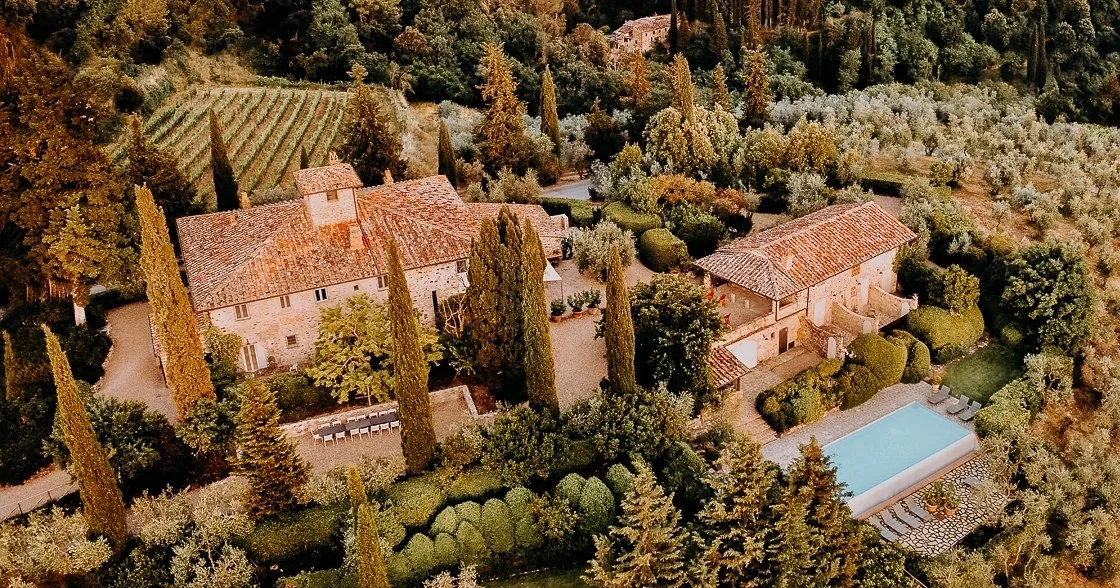
The meticulous restoration extended to the exterior environment, where honey-colored dry-stone walls frame the panoramic pool, creating a visual harmony with the surrounding vineyards and olive trees. The absence of gravel paths is another deliberate design choice; by utilizing smooth stone paving throughout the property, the estate ensures that guests in formal attire and heels can navigate the hamlet with ease. This level of logistical foresight is characteristic of the Borgo's approach to luxury, where the guest experience is refined through the elimination of friction.
Event Capabilities and Spatial Dynamics
Borgo di Vignamaggio is engineered for the "multi-day experience," a hallmark of the modern destination wedding where the transition between spaces is a critical component of the event's narrative flow. The estate's versatility allows for a "versatile approach to any event," where different locations are utilized for consecutive phases of a celebration. This spatial variety ensures that guests remain engaged throughout a three-day residency, as each new event phase reveals a previously unseen corner of the estate.
Ceremony and Reception Environments
The "Giardino delle Rose" (Rose Garden) and the "Pergola delle Rose" are primary outdoor locations for symbolic ceremonies, providing a romantic backdrop of manicured florals and Chianti vistas. The use of ground-level florals and asymmetric greenery is often employed to decorate the existing stone structures, blending the ceremony decor with the natural landscape. For couples seeking a more unconventional setting, the private theater offers a dramatic indoor alternative. Carved into the bedrock of the ancient wine cellar, the theater features low vaulted brick ceilings and professional lighting, creating an intimate, cinematic atmosphere.
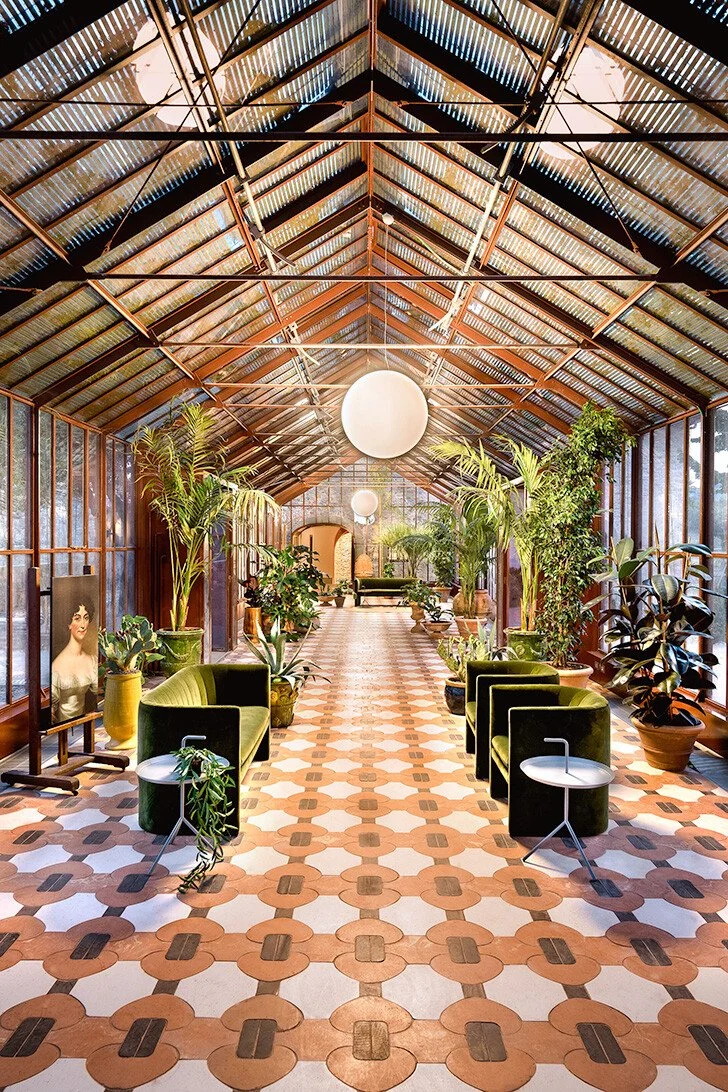
The "Serra" (Greenhouse) represents one of the most distinctive event spaces in Tuscany. As an iron-framed glass structure filled with tropical plants and flooded with natural light, it serves as a year-round "main stage" that is immune to the typical weather constraints of outdoor Tuscan weddings. It can accommodate up to 220 guests, making it suitable for large-scale dinners or indoor ceremonies. This space allows for highly creative experiments with tablescapes, such as mismatched glassware and hand-painted linens, which contrast with the more traditional stone and brick of the Borgo.
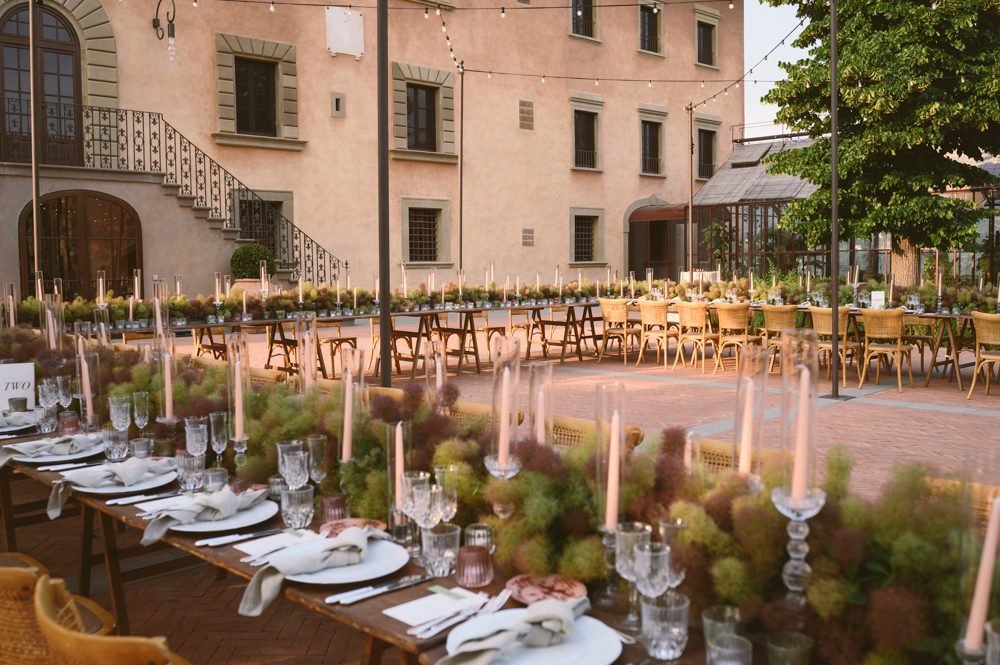
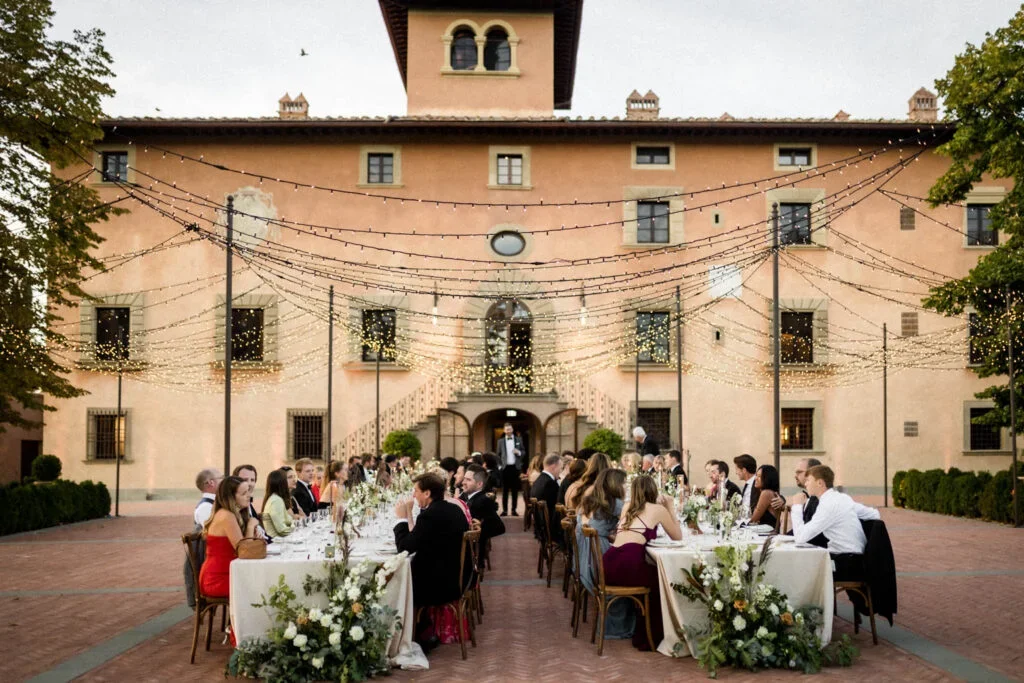
For the "aperitivo" or cocktail hour, the "Frutteto" (Orchard) and the "Belvedere" offer sweeping 360-degree views of the estate’s olive groves and vineyards. These spaces are often furnished with velvet sofas and low tables to create an outdoor lounge atmosphere that transitions into the formal dinner. The "Piazza della Villa" is typically the preferred choice for grand banquets under the stars, often featuring long imperial tables illuminated by strings of golden lights or overhead lanterns.
Contingency Planning: The "Plan B" Advantage
One of the most significant professional insights regarding Vignamaggio is the robustness of its contingency plans. Many Tuscan venues suffer from inadequate indoor alternatives for rain or extreme heat, often requiring the rental of expensive and aesthetically distracting marquees. In contrast, the Borgo offers multiple high-capacity indoor spaces that do not compromise on architectural quality. The combination of the Theater, the Greenhouse, and the Ballroom ensures that events for up to 150 guests can be moved entirely indoors without loss of ambiance.
Event Phase Primary Outdoor Location "Plan B" / Indoor Alternative
Welcome Dinner Poolside / Solarium La Fornace (Covered area)
Ceremony Rose Garden / Pergola Theater / Greenhouse
Cocktail Hour Frutteto / Belvedere Atrium Bar / Gallery
Wedding Banquet Piazza della Villa Greenhouse / Ballroom
After-Party Poolside Bar Dancing Hall / Disco
The presence of the dancing hall, often referred to as the "discoteca," is particularly critical for late-night programming. While many Tuscan venues are forced to end music early due to outdoor noise restrictions, the soundproofed nature of the internal dancing hall allows for celebrations to continue until 1:00 AM or 2:00 AM. This logistical capacity to house every phase of a complex event—regardless of weather or noise limits—is what elevates Vignamaggio into the upper echelon of global event destinations.
Hospitality and Accommodation Logistics
The Borgo di Vignamaggio operates as a "self-contained luxury resort," which is fundamentally different from a standalone villa. It functions as a private micro-village where guests can stay on-site, eliminating the logistical stress of transfers between hotels and the venue. This immersive model is ideal for high-budget destination weddings where the guest experience is a primary consideration.
On-Site Capacity and Layout
The hamlet itself provides seventeen suites, accommodating approximately 34 to 45 guests depending on the configuration of triple and quadruple rooms. A notable feature is the "Bridal Floor" in the Edificio della Torre, which contains the Bridal Suite and two additional rooms reserved for the couple's closest associates, ensuring privacy and proximity for pre-wedding preparations. The suites are characterized by unique details and handcrafted furniture, ensuring that no two guest rooms feel identical.
For children and younger guests, the eight-bed sleepover dormitory provides a "fairy-tale" environment that is both functional and evocative, allowing families to stay together while maintaining the luxury standard of the main suites. Each room is equipped with modern comforts including full air conditioning, WiFi, and luxuriously-appointed en-suite bathrooms.
Extended Accommodation Ecosystem
For larger weddings exceeding the Borgo’s immediate capacity, the estate manages a satellite network of sister properties and farmhouses within a ten-to-twenty-minute drive. This allows for a total guest count of approximately 104 to 130 people to be housed within the Vignamaggio management system.
L'Orto di Vignamaggio: A nine-bedroom farmhouse located five minutes away, featuring its own private swimming pool and a tranquil setting among olive trees.
Il Prato & Il Casolese: Additional stone farmhouses each offering nine double rooms, providing a more rustic but still high-end accommodation option.
Hotel La Pensione: A boutique hotel in the village of Panzano in Chianti, offering nineteen rooms (17 double and 2 triple) for overflow guests.
Property Location Rooms / Capacity / Features
Il Borgo (Main)On-site 17 Suites + 8 Dorm Beds 34-45 pax, Luxury design
L'Orto 5 min drive 9 Double Rooms Private pool, 18 pax
Il Prato 10 min drive 9 Double Rooms Private pool, garden
Il Casolese 10 min drive 9 Double Rooms 18 pax
La Pensione Panzano (20 min) 19 Rooms Boutique hotel, 40 pax
The venue provides a return shuttle service from midnight until the end of the event for guests staying in these nearby farmhouses, ensuring a safe and seamless experience. This network allows the estate to host larger guest lists (up to 250 for the event) while keeping the majority of the "inner circle" within the Vignamaggio management umbrella.
The Gastronomic Program and Food Philosophy
The gastronomic experience at Borgo di Vignamaggio is rooted in "authentic Tuscan tradition" but executed with the refinement expected of a global luxury destination. The estate’s 400 hectares include extensive organic vegetable gardens, orchards, and farmlands, which supply the kitchen with seasonal ingredients. This "farm-to-table" approach is not a marketing catchphrase but a foundational reality of the estate's operation, which includes its own oil mill, cheese room, and winery.
Catering Policies and Partnerships
The venue requires at least one in-house catered experience during the stay, ensuring that guests engage with the estate's own products. While they have an internal catering team that manages breakfasts, brunches, and pizza parties, they also collaborate with top-tier outside vendors for grand wedding banquets.
Partners such as Galateo Ricevimenti and Roland’s are frequently brought in to handle large-scale service, while Brindapino Catering is often utilized for more relaxed welcome dinners. The "show-cooking" of the wedding cake—specifically the traditional Italian millefoglie—is a frequent highlight, where the pastry chef assembles layers of crisp pastry, cream, and fresh fruit in front of guests.
Signature Menu Elements and Wine Integration
Wedding menus often feature regional specialties such as saffron risotto, timbale of eggplant, and beef fillet prepared with a sauce made from the estate's own Chianti Classico wine. The estate is particularly renowned for its winemaking tradition, which dates back to at least 1404. Guests typically enjoy tastings of the venue’s own labels, including Chianti Classico Riserva DOCG and Greppicaia Bolgheri Superiore DOC.
The "Ridolfi Bar" by the pool and the "Atrium Bar" offer daily service for resident guests, providing premium cocktails and estate-made soft drinks. For departing guests, the estate often provides "favors" such as small bottles of extra virgin olive oil, scented soaps, or vineyard-labeled wines, serving as a sensory reminder of the Chianti landscape.
Operational Framework: Pricing, Timing, and Curfews
Navigating the financial and regulatory aspects of a Vignamaggio wedding requires an understanding of the venue's exclusive-use model. The estate is not open for single-day rentals during peak season; it is designed for a full-weekend buyout that guarantees total privacy and a "stress-free event".
Rental Conditions and Costs
The exclusive use of the property is subject to seasonal variation and minimum stay requirements. Midweek weddings typically require a two-night stay, while weekend events require a three-night commitment. This ensures that the venue remains a destination for "immersive" experiences rather than a high-turnover event hall.
Financial Metric Estimated Value (2025/2026) Notes
Exclusive Rental Fee €30,000 to €33,000 per night Plus VAT (10-22%)
Total Wedding Budget €200,000 to €500,000+ For mid-to-large guest counts, Minimum Stay (Weekend) 3 Nights and Strict requirement for buyouts
Wedding Dinner From €220 per guest Standard tiered menu
Open Bar (2-hour) From €45 per guest Party phase only
Activities (BBQ/Brunch) From €140 per guest Optional weekend add-ons
The rental fee generally includes professional cleaning, WiFi, use of the heated pool, and the services of a night guard. One significant operational requirement is that the owners mandate the hiring of a professional wedding planner, ensuring that the complex logistics of the 400-hectare estate are managed by an expert.
Noise Regulations and Curfews
Italy's noise ordinances are among the strictest in Europe, particularly in rural municipalities where tranquility is a protected asset. However, Borgo di Vignamaggio's secluded location provides more flexibility than coastal or urban venues.
Outdoor Music: Permitted until midnight. Decibel limits are enforced at 85 dB until 10:00 PM and reduced to 80 dB between 10:00 PM and midnight.
Indoor Music: Once the party moves into the "discoteca" or dancing hall, music can continue until 1:00 AM or 2:00 AM.
Integrated Sound System: The venue has recently installed its own internal sound system to manage sound pollution, though some reviewers have noted it is calibrated for moderate rather than extreme volumes.
Regulatory Requirements: SIAE Permits
Any event in Italy featuring music (live or recorded) requires a SIAE license (Italian Authors' and Publishers' Association). This is a mandatory copyright royalty that must be paid by the event organizer. The cost depends on the number of guests, the type of music (live band vs. DJ), and the inclusion of dancing. Failure to obtain this license can result in heavy fines or the police interrupting the event to check documentation.
Creative Potential: Photography, Cinematography, and Aerial Aesthetics
From a visual standpoint, Vignamaggio is considered a premier "editorial-quality" setting for photography and film. The intentional design of the landscape—including the removal of utility poles—and the sensitive restoration of the buildings provide a multitude of textures and lighting conditions for high-end documentation.
Prime Locations for Portraiture
The "golden Chianti light" is a central element of the estate’s photographic appeal, particularly for destination clients seeking the iconic Tuscan aesthetic.
The Vineyards and Olive Groves: Ideal for sunset portraits where the rolling hills provide a timeless backdrop.
Stone Courtyards and Medieval Walls: These offer a quieter, more intimate setting for bridal portraits, away from the main event flow.
The Champagne Tower Terrace: A signature shot location where the champagne tower is set against the panoramic valley during the transition to dinner.
The Theater: Provides a moody, dramatic alternative for couples interested in high-fashion, high-contrast imagery.
Drone Regulations and Aerial Photography
Aerial footage is increasingly vital for high-budget weddings to capture the scale of the estate. While Borgo di Vignamaggio is drone-friendly with prior approval, operators must strictly adhere to ENAC (Italian Civil Aviation Authority) and EASA regulations.
Operator Registration: All drone pilots must be registered on the D-Flight portal and hold a valid operator ID.
Altitude and Proximity: Flights are capped at 120 meters (400 feet). Pilots must maintain a visual line of sight (VLOS) and remain at a safe distance from uninvolved persons.
Insurance: Commercial drone use in Italy requires specific liability insurance; operating without it can result in fines up to €64,000.
No-Fly Zones: While the Borgo itself is open, nearby historic centers like Florence are "red zones" where drone flight is strictly prohibited without special military permits.
The Regional Tapestry: Guest Experiences in Chianti Classico
The strategic location of Borgo di Vignamaggio, halfway between Florence and Siena, makes it an ideal base for guests to explore the broader Chianti region. Providing a curated list of local experiences is a hallmark of the premium guest experience.
Greve in Chianti
Located only five kilometers from the estate, Greve is the principal town of the wine region.
Piazza Matteotti: The heart of the town features a triangular square surrounded by porticos. Guests can visit the Santa Croce Church, which contains works from the school of Beato Angelico.
Wine Tasting: Numerous enoteche on the square offer guided tastings of local vintages. The Chianti Classico Expo in September is a major draw for enthusiasts.
Macelleria Falorni: A historic butchery where guests can sample cured meats and cheeses in a traditional bistro setting.
Panzano and Montefioralle
Panzano in Chianti: Just a ten-to-fifteen-minute drive away, this village is famous for its Romanesque church, San Leolino, and the world-renowned butcher Dario Cecchini.
Montefioralle: One of the oldest villages in the region, still enclosed in medieval walls. Its compact stone houses and winding streets provide a tranquil alternative to the busier markets of Greve.
Lamole: A smaller village nestled higher in the hills, known for offering some of the most striking panoramic views in Chianti, perfect for a photographic stop.
The presence of high-quality local dining—from the Michelin-starred Osteria di Passignano to the rustic charm of Lo Spela—ensures that guests can enjoy a variety of gastronomic experiences during their stay. The estate's concierge service can also arrange activities such as horseback riding, hiking, and hot air balloon tours over the vineyards.
Nuanced Operational Perspectives: Challenges and Professional Insights
While Borgo di Vignamaggio represents a pinnacle of restoration and luxury, professional event planners must account for several nuanced operational realities to ensure a flawless execution.
The Sound Tension
There is an inherent tension between the "exclusive hamlet" branding and the strict noise regulations of the Chianti Classico region. Some reviewers have noted that the venue’s integrated sound system is calibrated for "environmental harmony" rather than high-decibel parties. Planners should discuss acoustic requirements early with the venue to understand exactly how much amplification is permitted in both the outdoor piazza and the indoor dancing hall.
Staffing and Responsiveness
The Borgo is part of a large, complex agricultural estate. During the high season, the management of multiple satellite farmhouses and the boutique hotel can stretch administrative resources. The venue’s requirement for a professional wedding planner is a strategic safeguard; it ensures that the "fine detail" promised by the estate is managed by a dedicated liaison who can navigate the venue's internal hierarchies.
Logistics and Accessibility
The conversion of a fifteenth-century hamlet into a luxury hotel involves inherent challenges with accessibility. While the venue is categorized as "child friendly" and "disabled access" compliant, the stone-paved slopes and multi-level layout of the Borgo still require careful consideration for guests with mobility impairments. Furthermore, the lack of traditional gravel paths is a significant benefit for formal footwear, but it requires that all heavy equipment for event setup (stage components, florals, lighting) be moved via specialized carts to avoid damaging the stone paving.
Weather Vulnerability
Despite the excellent "Plan B" options, the quintessential "Vignamaggio dream" is often an outdoor dinner in the piazza. Planners must be transparent with clients about the rapid temperature drops that can occur in the Chianti hills once the sun sets, even in July or August. Coordinating the timing of the champagne tower and the transition to dinner is critical to ensuring guests are seated before the evening dampness sets in.
Conclusion
The restoration of Borgo di Vignamaggio serves as a definitive case study in the contemporary "Renaissance" of the Tuscan estate. By moving beyond the traditional farmhouse aesthetic and embracing global design standards (Baxter, Davide Groppi, Viabizzuno), the estate has positioned itself as a unique product in a crowded market. It offers a rare combination of historical depth—anchored by the Verrazzano and Gherardini legacies—and architectural resilience, particularly through its high-capacity indoor "Plan B" spaces like the Greenhouse and the private theater.
For the professional event integrator, Vignamaggio represents a high-investment but low-risk asset. The risk is mitigated by the property’s self-contained nature; the ability to house the core guest list on-site and the secondary guest list in nearby management-run properties provides a level of control over the "bubble" of the event that is difficult to achieve with disparate hotel blocks. The strategic decision to remove modern visual clutter (utility poles) and replace gravel with stone paving demonstrates a profound understanding of the aesthetic and logistical requirements of the ultra-high-net-worth market.
Ultimately, the success of an event at Vignamaggio depends on the planner’s ability to weave the estate’s history and products—its wines, its oils, its stone walls—into a cohesive narrative that spans multiple days. It is a venue that rewards slow immersion, encouraging guests to "lose themselves around every corner" and engage with the "Dolce Vita" not just as a concept, but as a lived reality. As the estate continues to mature, it will likely remain a benchmark for the sensitive, sophisticated integration of history, agriculture, and high-tier hospitality in the heart of Italy.
Contact and Booking Information
To begin planning your wedding at Borgo di Vignamaggio or to request a detailed brochure and viewing appointment, you can reach the estate's management through the following official channels:
Official Website: vignamaggio.com
Events & Wedding Email: eventi@vignamaggio.com
Main Telephone: +39 055 854 6671
Instagram: @vignamaggio
Physical Address: Via Case Sparse (Panzano), 62, 50022 Greve in Chianti, Italy